

Bill C-3 Comes Into Force, Opening a Clear Pathway to Canadian Citizenship for Thousands
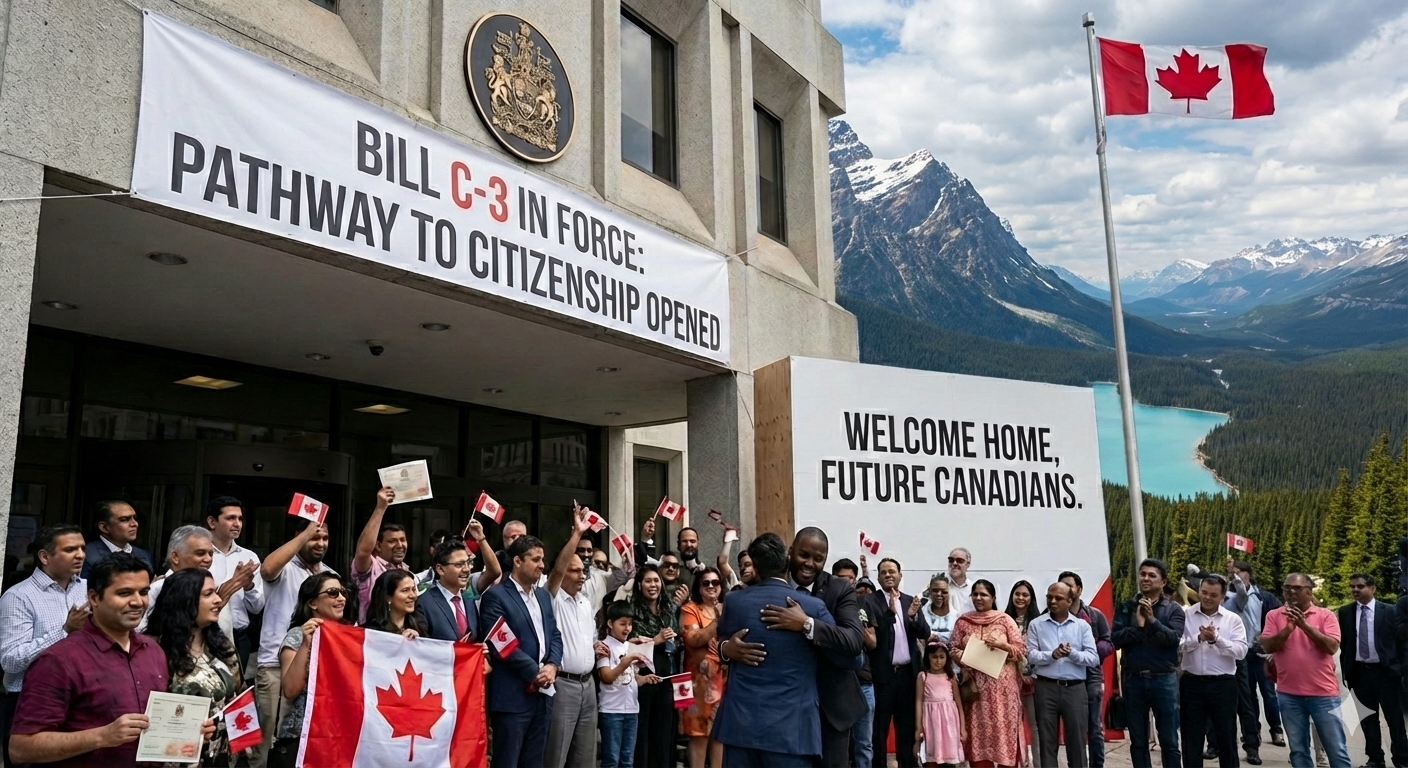
Bill C-3 has officially become law, bringing long-awaited changes to Canada’s citizenship rules and restoring eligibility for thousands of people often referred to as “lost Canadians.”
On December 15, 2025, Bill C-3, formally titled An Act to Amend the Citizenship Act, came into effect. The new law removes long-standing restrictions that prevented certain individuals from passing on or claiming Canadian citizenship due to outdated rules.
According to Immigration Minister Lena Metlege Diab, the legislation strengthens the connection between Canadians living in Canada and those abroad, while reaffirming Canada’s core values of fairness and inclusion.
Who benefits from Bill C-3?
The most significant impact of Bill C-3 is the removal of the first-generation limit (FGL) for citizenship by descent in many cases.
Individuals born before December 15, 2025
Anyone born before December 15, 2025, who would have been a Canadian citizen if not for the first-generation limit or similar outdated rules, is now recognized as a Canadian citizen. These individuals can apply for proof of Canadian citizenship under the updated law.
New rules for children born abroad after December 15, 2025
For children born outside Canada on or after December 15, 2025, Canadian citizenship will be granted if the following conditions are met:
At least one parent was a Canadian citizen at the time of the child’s birth; and
The Canadian parent meets the substantial connection to Canada requirement.
Substantial connection to Canada test
To pass this test, the Canadian parent must prove they were physically present in Canada for at least three years (1,095 days) before the child was born.
This requirement ensures a meaningful connection to Canada while allowing citizenship to be passed on beyond the first generation.
What happens to applications submitted earlier?
Immigration, Refugees and Citizenship Canada (IRCC) has confirmed that applications submitted under the interim measures introduced in 2023 will now be processed under the amended Citizenship Act.
Applicants who already filed a proof of citizenship application under these interim rules do not need to submit a new application now that Bill C-3 is in force.
Citizenship may be granted or restored in additional cases
Depending on individual circumstances, the amended Citizenship Act may also grant or restore Canadian citizenship to:
Individuals born outside Canada whose parent was already a Canadian citizen at the time of birth
Individuals whose parent became a Canadian citizen due to the new legislative changes
Individuals who previously lost their Canadian citizenship under older provisions
Each case will be assessed based on the specific facts and eligibility criteria.
Background and history of Bill C-3
Bill C-3 follows nearly two years of legal challenges and legislative delays.
In December 2023, the Ontario Superior Court ruled that the second-generation limit in Canada’s Citizenship Act was unconstitutional. The court found that the law created unequal classes of Canadian citizens by limiting the ability of some citizens to pass on their citizenship.
The federal government chose not to appeal the decision and instead committed to amending the Act. Although initially given a deadline in 2024, the government missed multiple timelines and requested extensions, with the final extension granted on November 18, 2025.
The bill received Royal Assent on November 20, 2025, making the final extension unnecessary and clearing the way for the law to come into force on December 15, 2025.
Why Canadian citizenship matters
Canadian citizenship offers several rights and protections that permanent residents do not have, including:
The right to vote in federal, provincial, and municipal elections
Guaranteed right of entry into Canada and protection from inadmissibility
Greater flexibility to sponsor a spouse or common-law partner from abroad
Eligibility for certain political roles and positions requiring security clearance
The right to hold a Canadian passport
What this means going forward
Bill C-3 marks a major shift in Canada’s approach to citizenship by descent. By removing outdated restrictions and recognizing genuine connections to Canada, the new law provides clarity, fairness, and long-term certainty for families with ties to Canada across generations.